Home The work 02
Discipline 02

AI & Simulation.

Bringing machine learning and physics together to explore complex systems, optimize spacecraft, and build autonomous coordination strategies.

Machine learningPhysics simulationSystem optimization
Case study 01 / Luminary · Anonymized Customer

Physics AI for Aerodynamic Databases

More than two months saved per design iteration, with trained Physics AI models generating aerodynamic databases in under an hour.
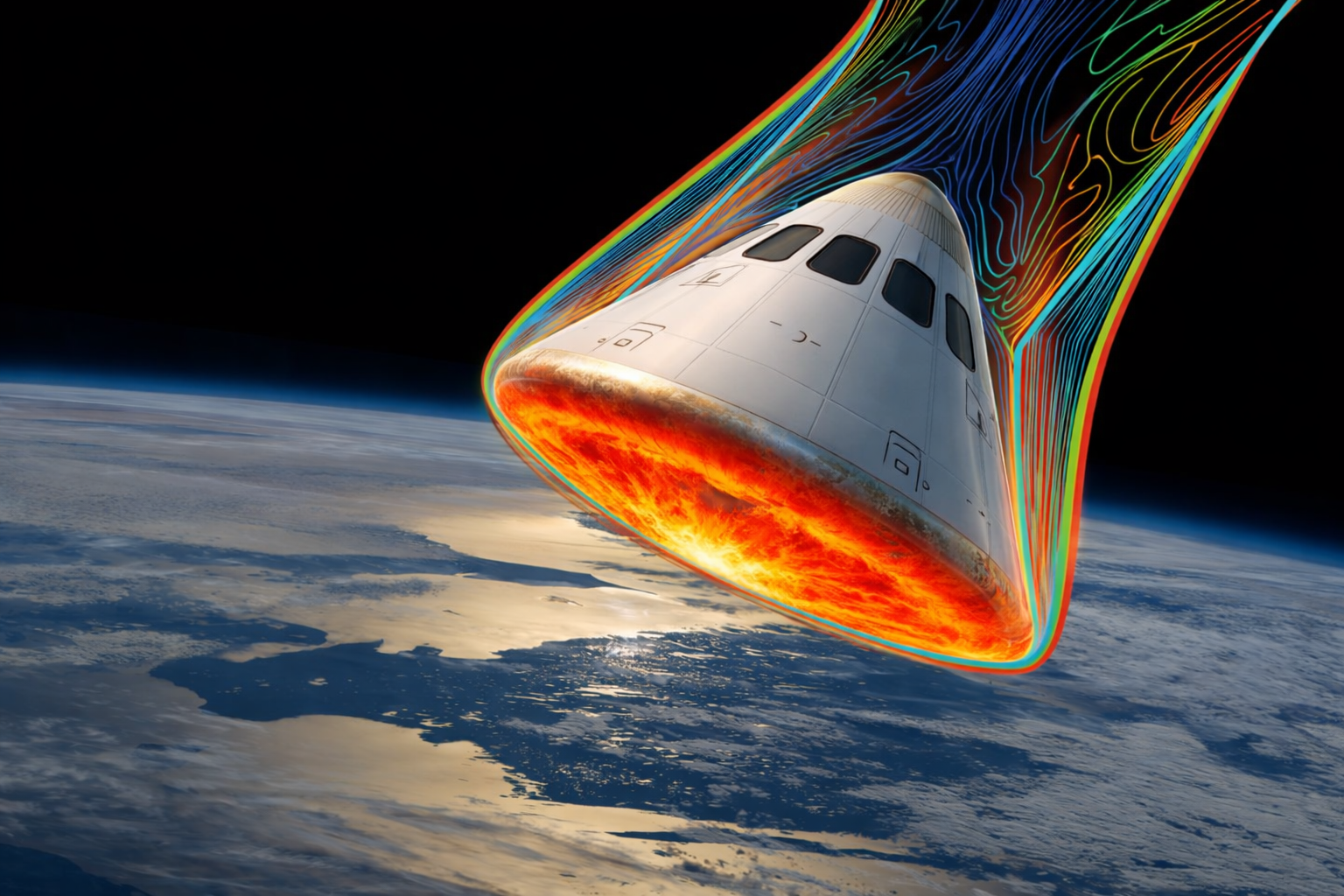
Illustration of a capsule during atmospheric re-entry.

Business context

An aerospace engineering team needed aerodynamic databases to evaluate vehicle performance across operating conditions. Each design iteration depended on a new database generated with an established high-fidelity simulation workflow.

The challenge

Make aerodynamic database generation fast enough to support the customer’s engineering workflow, while validating model predictions against high-fidelity simulation results.

My role

I led the project end to end: CAD preparation, simulation execution, data-generation oversight, model training, inference code, customer integrations, and ongoing technical collaboration. I used Luminary’s existing machine learning infrastructure and worked with AI/ML engineers to improve model architectures.

Contributions & implementation

  • Geometry & Simulation: Built the CAD model and ran the high-fidelity CFD simulations used to generate training data.

  • Pipeline Delivery: Monitored data generation, debugged simulation-pipeline issues, and resolved delivery blockers throughout the project.

  • Model Training & Validation: Trained the Physics AI models and validated predictions against held-out simulation data, achieving less than 5% mean absolute percentage error on forces and approximately 10% error on moments.

  • Inference & Integration: Built the customer-facing inference code and integrations so the engineering team could generate aerodynamic databases using the trained model.

  • Iteration & Product Feedback: Worked directly with the customer to improve model performance, translated delivery feedback into product-engineering improvements, and collaborated with AI/ML engineers on more effective model architectures.

The impact

After an up-front simulation campaign and model training, the model generated an aerodynamic database in under one hour, saving more than two months per design iteration compared with the prior workflow.

Delivered the inference workflow for use in the customer’s production engineering organization, with continued iteration based on engineering feedback.
Case study 02 / Blue Origin

Large Scale Space System Optimization

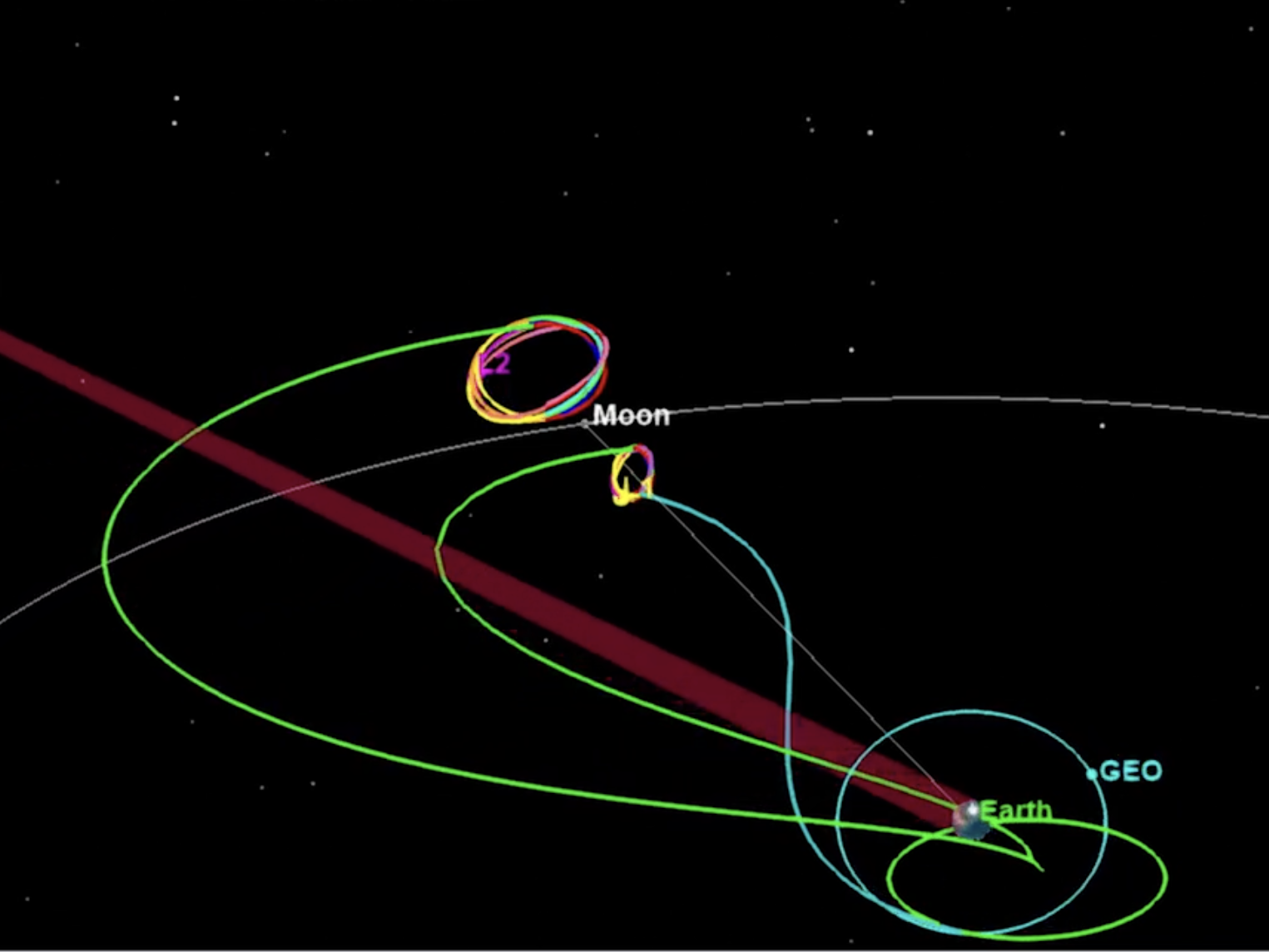
A simulation-to-optimization pipeline for a three-spacecraft lunar system.

Screenshot of AGI STK Lunar Mission. Original source: Cis-Lunar Applications — Product Demo.

Business context

Blue Origin will land humans on the Moon this decade. To achieve this, three spacecraft must cooperate as one system, requiring extreme performance optimization to achieve this technical challenge.

The challenge

Develop a data and simulation pipeline to minimize spacecraft mass while meeting crew safety requirements.

My role

Conceived, built, and applied an end-to-end system optimization pipeline.

Contributions & implementation

  • Built a Python library to automate NASA simulation runtime, integrated with HPC and ML (Dask, scikit-learn, PyTorch).

  • Led development of finite element models and system architectures for three spacecraft, with total complexity comparable to the International Space Station.

  • Implemented a genetic algorithm for a non-differentiable problem; designed a multi-domain fitness function, tuned with Bayesian optimization and surrogate models.

  • Built and administered an on-premise compute cluster to scale simulations.

  • Directed cross-team collaborations (Structures, Thermal, Fluids & Propulsion, Avionics, Communications, Mission Design) to implement vehicle-wide mass savings.

The impact

Delivered ~200 kg mass savings to Blue Moon MK2 Crew Lander vehicle by removing unnecessary material while ensuring crew safety.

Case study 03 / Independent Project

Multi-Agent Reinforcement Learning (MARL) of Competitive Satellite “Tag”

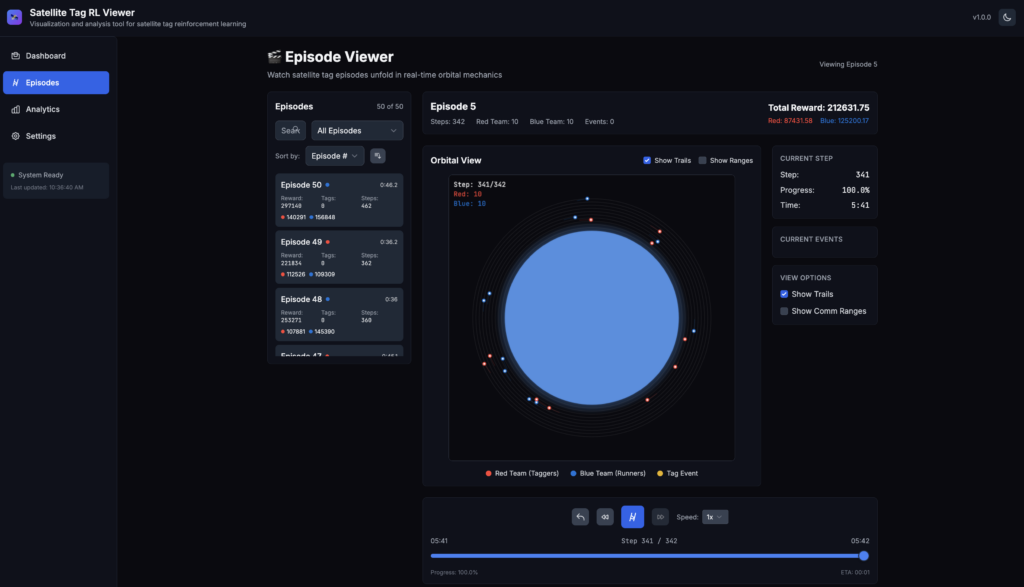
Competitive satellite constellations learning pursuit, evasion, and coordination.

Screenshot of MARL Simulation Dashboard.

Business context

Large satellite constellations require autonomous spacecraft guidance systems to avoid collisions. I posed myself the questions: What behaviors and system optimizations might evolve if you were trying to maximize the probability of collision in a game of tag? How would I build the MARL?

The challenge

Maximize the probability of conjunction for a satellite constellation (blue team) and minimize probability of conjunction for another constellation (red team).

My role

I ideated and implemented this project in my free time.

Contributions & implementation

  • Multi-Agent RL Framework: Built PettingZoo-compliant MARL system with competitive satellite constellations, 94-element observations, 7 actions, and adversarial team training.

  • Space Physics Engine: Modeled atmospheric drag, collision debris, and spatial grid collision detection with O(n log n) performance.

  • Game Mechanics: Designed “Space Tag” pursuit/evasion gameplay with scoring (+100 tags, −15 clustering) and variants like King of the Hill.

  • Training Pipeline: Created curriculum learning (0–100 debris), adaptive team balancing, multi-objective optimization (competition, safety, fuel), and Proximal Policy Optimization (PPO) with reward shaping and clipping for stable multi-agent training.

  • Software Architecture: Delivered modular Python package with physics components, test suite, CLI, and automated visualization in JS/React.

  • Scalability & Performance: Optimized for 100+ satellites, enabling rapid training (80 episodes/minute) with real-time analytics and behavior tracking.

The impact

Developed a competitive Multi-Agent Reinforcement Learning framework for satellite constellations, training hundreds of agents in realistic space physics to demonstrate scalable coordination strategies for space traffic management, collision avoidance, and defense tech.

Continue exploring / 03

Hardware Delivery